
Automate theInvoice Loop withAgentic AI
PINT AE Invoicing Made Easier with FinIQ.
FinIQ turns delivered invoices into validated, matched, approved, ERP-posted payables. The messy part between receipt and payment becomes a controlled workbench.
PEPPOL is coming to the UAE.
Here's what that means.
The UAE Federal Tax Authority is mandating structured e-invoicing for all VAT-registered businesses. PEPPOL is the network it runs on. This is what every finance team needs to understand.
What is PEPPOL?
A global network for exchanging invoices as structured data — not PDFs.
Instead of emailing PDFs or uploading CSVs, businesses send invoice data in a machine-readable format through certified service providers. Every field — supplier, amount, tax, PO reference — travels as structured data that systems can validate and act on automatically.
Machine-readable
Invoices arrive as structured data, not image files or PDFs.
Certified channel
Accredited ASPs validate, sign, and transmit through PEPPOL.
FTA reporting built in
Tax data reports to the Federal Tax Authority automatically.
PINT AE — The UAE-Specific Standard
PINT AE (PEPPOL International for UAE) is the official invoice format mandated by the UAE Federal Tax Authority. Built on PEPPOL BIS Billing 3.0 with UAE-specific extensions — TRN validation, Arabic field support, and VAT treatment rules — it is the exact schema every invoice must conform to.
PEPPOL BIS 3.0 base
Built on the global PEPPOL billing standard.
UAE TRN validation
Tax Registration Number checked at schema level.
FTA-recognised format
The only accepted structured invoice format for UAE VAT.
Why did the UAE mandate it?
The FTA needs real-time tax visibility. Manual invoicing can't provide it.
Under the current system, invoices are exchanged informally — emails, portals, paper. The FTA has no direct line of sight into VAT transactions until returns are filed. Structured e-invoicing closes that gap: every transaction is reported at the point of exchange, not weeks later.
39%
of invoices contain errors that delay payment or reporting
$5B+
lost annually to AP fraud that structured data helps detect
Who needs to act — and when?
Compliance is mandatory. The question is whether you're in the first wave.
The UAE mandate rolls out in three phases based on annual revenue. Large enterprises are first. Mid-market follows. Eventually every registered business must comply. If your revenue crosses AED 50M, the clock is already running.
Urgent
AED 150M+
Annual revenue
UAE crown companies included
Soon
AED 50M+
Annual revenue
Mid-market rollout
2028+
All
Businesses
Full coverage
Rollout timeline
Every deadline, in order.
23 Feb 2026
Guidelines issued
All businesses1 Jul 2026
Pilot phase starts
Selected taxpayers30 Oct 2026
ASP deadline
≥ AED 50M1 Jan 2027
Mandatory Phase 1
≥ AED 50M31 Mar 2027
ASP deadline
< AED 50M + Gov1 Jul 2027
Mandatory Phase 2
< AED 50M1 Oct 2027
Government phase
Gov entities1 Jul 2026
Pilot phase starts
Selected taxpayers1 Jan 2027
Mandatory Phase 1
≥ AED 50M1 Jul 2027
Mandatory Phase 2
< AED 50M23 Feb 2026
Guidelines issued
All businesses30 Oct 2026
ASP deadline
≥ AED 50M31 Mar 2027
ASP deadline
< AED 50M + Gov1 Oct 2027
Government phase
Gov entitiesWhere FinIQ fits in
Your ASP handles the mandate. FinIQ handles everything after.
Once the compliant invoice lands in your environment, FinIQ runs every post-receipt workflow — validation against business rules, 3-way matching, exception routing, approval orchestration, ERP sync with GL coding, and payment release. No mandate expertise required from your finance team.
E-Invoicing,
without the
AP mess.
Under the UAE e-invoicing mandate, your ASP validates the PINT AE schema, signs digitally, and routes through the PEPPOL network to the FTA. FinIQ picks up at the handoff — running every post-receipt workflow through to payment release.
Pre-integrated with PEPPOL-certified, PINT AE-compliant ASPs. No mandate expertise required from your finance team.
PEPPOL Network — Certified Integration
Pre-connected to UAE-accredited ASPs — no compliance setup required
PINT AE — UAE Format Compliant
Invoices processed in PINT AE schema — FTA-recognised format by design
Supplier issues invoice
Supplier's ASP validates, signs & transmits via PEPPOL
FTA receives tax data report
Buyer's ASP validates & delivers to buyer
Handoff Point
Validated invoice enters FinIQ AP workspace
Business-rule validation, anomaly detection
3-way match against PO and GR
Exception handling, approval orchestration
ERP sync, GL coding, reconciliation
Payment scoring, fraud check, release
Supplier communication, status updates
Reverse MLS Communication To PINT AE Network
Invoice paid · Audit trail closed
What FinIQ Actually Does
The work between invoice receipt and payment.
FinIQ is the layer that decides what can move, what needs review, who owns the exception, and what should be posted back to the ERP.
Finance keeps the ERP. FinIQ removes the manual glue around it.
See it on your invoicesDecide what is safe to process
Business rules, supplier master checks, duplicate detection, tax validation, PO/GRN/contract match, and fraud signals run before approval.
Send exceptions to the right owner
Missing PO, unmatched GRN, blocked supplier, or ERP posting failure each gets routed with context instead of landing in one shared queue.
Control payment release
Approved invoices are scored for payment timing and released through banking partners with remittance and audit visibility.
Show finance where work is stuck
Cycle time, exception type, supplier performance, posting failures, and working-capital risk are visible without exporting spreadsheets.
Invoice receipt to Payment release.
Each stage has an owner, a rule set, and an audit trail: extraction, validation, matching, approval, ERP sync with GL coding, and payment scoring.
Input
Invoices, POs, GRNs
Control
Rules, match, approval
Output
ERP posting + payment
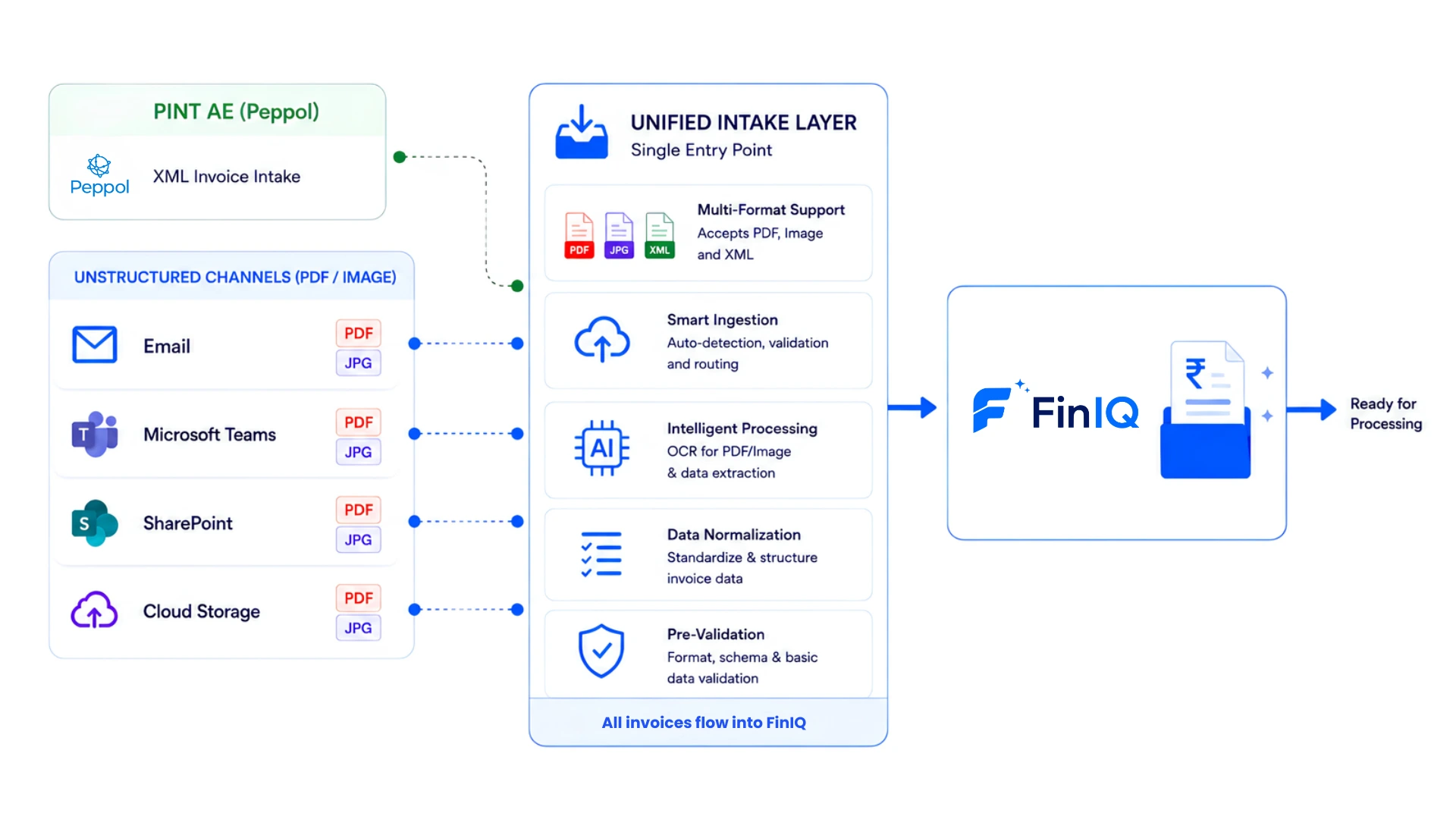
Supplier Document Ingestion
Capture invoices, POs, GRNs, and credit notes from email, portal, upload, scan, and ERP exports into a centralized AP workspace.
Exceptions get an owner, not a dumping ground.
FinIQ shows what failed, why it failed, who should fix it, and what evidence is needed before the invoice can move forward.
Supplier not found in ERP master
Routed to vendor master team for creation or mapping
GST number mismatch on invoice
Flagged to AP team with extracted vs expected values
Duplicate invoice detected
Blocked automatically. AP team notified with reference
PO number missing or mismatched
Routed to procurement for PO reference confirmation
GRN not received or quantity mismatch
Hold placed. Vendor and warehouse team notified
ERP posting failed
Failure captured, logged, and re-queued for manual retry
PEPPOL network delivery failure
ASP rejection logged. Supplier notified to resubmit via fallback channel
Every invoice leaves a trail.
From ingestion to ERP posting, each decision is timestamped with extracted values, validation outcomes, ERP responses, and user actions.
Invoice received
INV-2024-8821 from Acme Corp — email attachment
Categorized
Goods Invoice — PO-based — routed to AP flow
Data extracted
Confidence 98.4% — 24 fields extracted, 0 missing
Validations passed
14/14 guardrail checks — no policy violations
3-way match confirmed
PO-9921 × GRN-447 × INV — within tolerance
Auto-approved
Invoice value below approval threshold (AED 50,000)
Posted to ERP
VCH/PI/24-25/4821 — ERP response: success
MLS sent to Supplier ASP
ApplicationResponse dispatched — Corner 2 acknowledged receipt
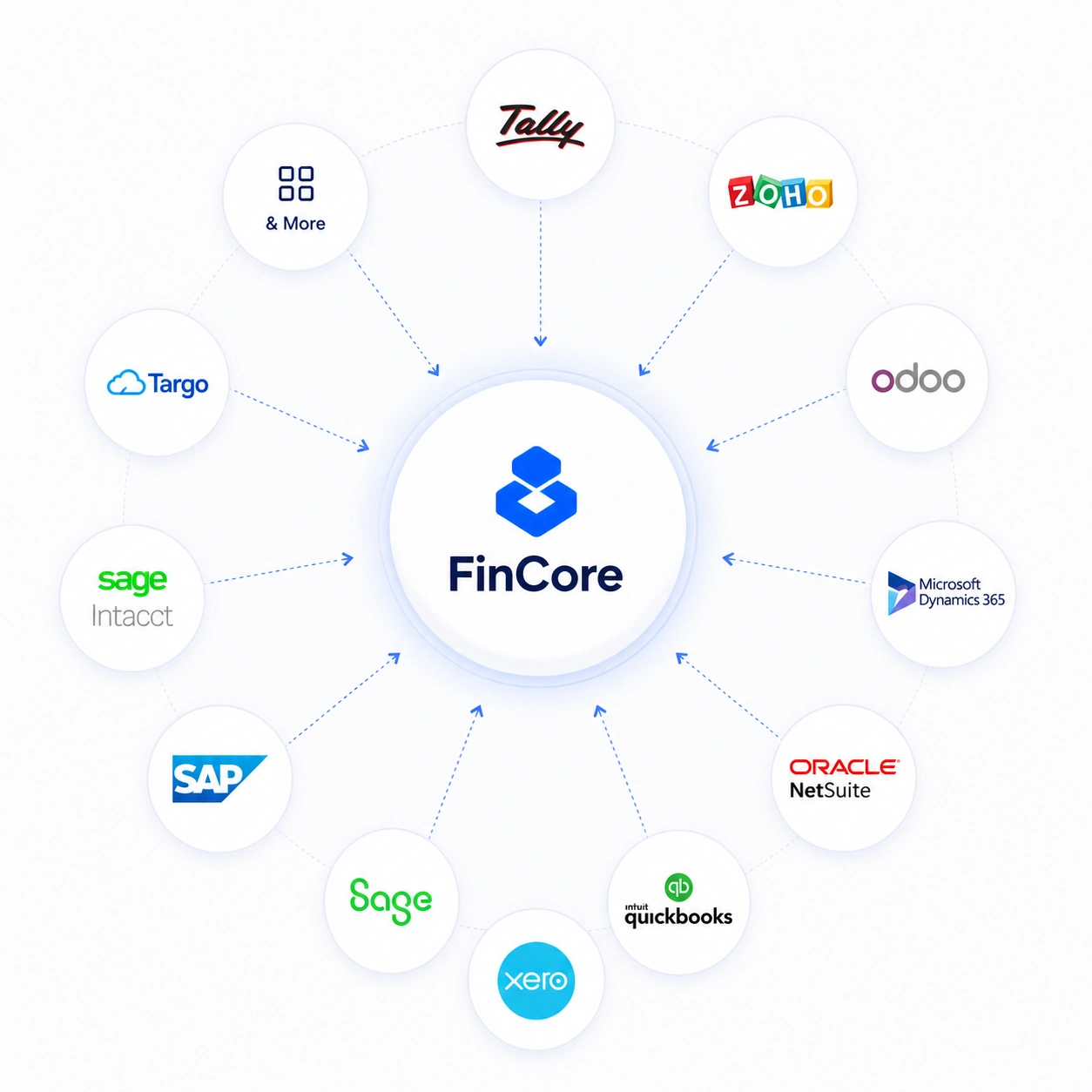
Keep the ERP. Replace the manual glue.
FinIQ sits above your finance system, reads and validates the work, then posts back clean records with the right reference trail.
What Changes In The Queue
The finance team gets its week back.
0%+
Clean invoices can skip manual touch
after rules and matching pass
0.8%
Extraction accuracy
validated before ERP posting
0%
Cycle-time reduction
receipt to approved payable
0%+
Exceptions auto-resolved
no human touch required
Customer Outcome
From 11-day cycles
to same-day payables.
A regional conglomerate processing 18,000+ invoices monthly across 6 entities replaced a fragmented email-and-ERP workflow with FinIQ. Within 8 weeks of go-live, AP became a single controlled queue.
82%
reduction in manual touches
11→1
day average cycle time
3.2 FTE
redeployed to strategic work
0
duplicate payments since go-live
"Our AP team spent three days a week chasing approvals and reconciling mismatches. Now exceptions come to them — everything else moves without a touch. The ERP still runs exactly as it did. FinIQ just handles what happens before the posting."
Head of Accounts Payable
Manufacturing & Distribution · UAE · 18,000 invoices/month
See FinIQ in motion.
Watch how invoices move from receipt through validation, exception routing, ERP posting, and payment readiness.
Bring your messiest invoice flow
Let us walk it
invoice by invoice.
We will map what arrives, what breaks, who touches it, and what should post back to the ERP. Then we show where automation can safely take over.